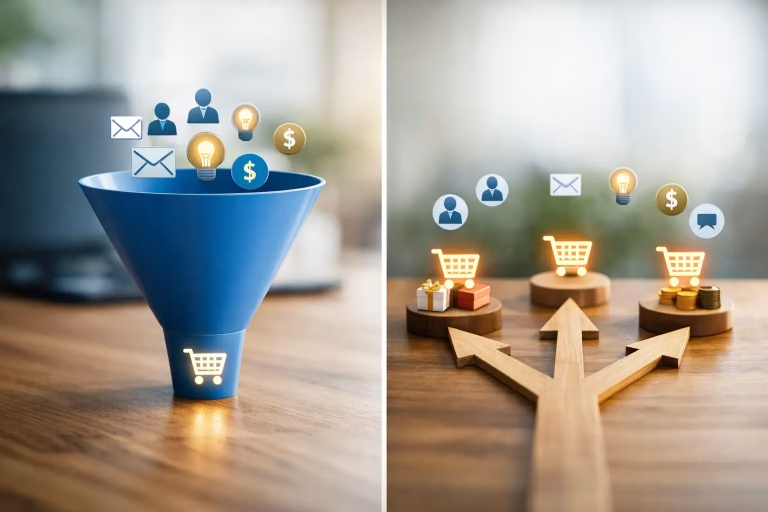
How to Build Faceless Funnels That Compound
A faceless funnel is not a website with your name removed. It is a decision system: a clear path that takes someone from a specific problem to a useful next step, without requiring you to perform, post constantly, or become the product. Learning how to build faceless funnels means designing that path before you worry about content volume, logos, or automation.
That distinction matters. Many quiet builders collect lead magnets, affiliate links and email tools, then connect them loosely. The result is more moving parts, more second-guessing and little reason for a visitor to continue. A well-built funnel does the opposite. It reduces choice for both you and your audience.
Faceless does not mean disconnected
People do not need a creator’s face to trust a recommendation. They need relevance, clarity and evidence that the next step will help them solve the problem they arrived with.
A faceless brand can create this trust through well-organised information, useful examples, transparent recommendations and consistent positioning. Think of a practical guide that answers the question someone is already researching, then offers a worksheet, template or email series that helps them apply it. The value is in the structure, not the personality performance.
There is a trade-off. A personal brand can sometimes build familiarity faster because audiences form a relationship with the person. A faceless model usually earns attention more slowly through usefulness and search intent. In return, it can be easier to maintain, more private and less dependent on your energy being publicly available every day.
The goal is not to be invisible to the customer. The goal is to make the system visible enough that they understand what is being offered and why it fits their situation.
How to build faceless funnels from one clear problem
Start with one audience problem that has a practical outcome. “Earn online” is too broad. “Choose an affiliate offer that fits a beginner email funnel” is specific enough to build around. The narrower starting point gives your traffic, capture asset and offer a shared direction.
This is the core logic: traffic arrives with intent, the opt-in helps them make progress on that intent, and the paid or affiliate recommendation continues the same journey. If any part changes the subject, the funnel loses momentum.
For example, a reader searching for ways to organise a simple digital income system may land on an article about funnel structure. A useful next step could be a concise blueprint that maps traffic, capture and monetisation. The follow-up emails can then explain how to choose one traffic channel, one lead capture mechanism and one aligned offer. Nothing has to be loud. It simply has to make sense.
Before building pages, define four components in a single working document:
- The search question or traffic theme that brings people in.
- The immediate problem your lead capture asset helps them clarify or solve.
- The offer category that naturally follows that asset.
- The proof, examples or reasoning that makes the recommendation credible.
If you cannot describe the connection between these four components in a few plain sentences, do not add more tools. Stabilise the logic first.
Choose traffic with buying context, not vanity metrics
Faceless funnels work especially well with intent-led traffic. Search-focused articles, Pinterest content, partner referrals and niche newsletters can all work because the visitor is already looking for an answer. The best channel depends on your topic and capacity, but each channel needs a defined role.
Search content is often a strong fit for patient builders because an article can remain useful long after publication. Pinterest can suit visual planning, templates and resource-led topics. Partnerships can work when another publisher already serves an adjacent audience. Do not try to establish all three at once. One reliable traffic source connected to one funnel is more useful than scattered visibility.
Avoid sending broad traffic to a generic homepage. Send visitors to the most relevant article or landing page, where the next action matches the reason they clicked.
Create a capture asset that closes a small gap
A lead magnet should not be a pile of information. It should help someone make one decision, complete one task or see one process more clearly.
A checklist might work when the visitor needs to audit an existing funnel. A template may be better when they need a starting structure. A short email course can work when the topic requires a sequence of decisions. The format matters less than the outcome.
Keep the promise modest and specific. “Plan your entire business” creates pressure and attracts broad, uncertain subscribers. “Map your first traffic-to-offer path” gives the right person a reason to opt in and gives you a logical subject for the emails that follow.
Build the offer path before writing the emails
The common mistake is treating emails as a separate content project. They are not. Their job is to help subscribers move from the problem they recognised on the page to a suitable solution.
A simple starting sequence can have four emails. The first delivers the resource and reinforces the problem it solves. The second explains the mistake or friction that keeps the problem in place. The third shows the framework or decision criteria behind a better approach. The fourth introduces the relevant next step, whether that is a low-cost digital product, a core offer or an ethical affiliate recommendation.
This is not a pressure sequence. You do not need manufactured deadlines or inflated promises. A calm recommendation can be more persuasive because it gives the reader room to assess fit. State who the offer is for, what it helps with, and where it may not be the right choice.
Ethical affiliate monetisation belongs here when the product genuinely supports the next stage of the funnel. If an email about choosing an email platform includes a relevant tool recommendation, that is useful. If the same email suddenly promotes an unrelated course because the commission is higher, it breaks trust and weakens the system.
Use a low-complexity stack
The tool stack should support the funnel, not become another project to manage. At minimum, you need a site or landing page builder, an email platform, a way to deliver your digital asset, and basic analytics.
Choose tools based on the system you can maintain. A simple landing page, a tagged email form and an automated delivery email are enough for an initial funnel. More advanced branching, dashboards and integrations can wait until you have a clear reason to use them.
Set up tracking from the beginning, but keep it practical. Monitor where subscribers came from, which pages generate opt-ins, and whether subscribers progress to the recommended offer. These numbers tell you where the alignment is weak. Low traffic may point to distribution or topic selection. Healthy traffic with few opt-ins usually points to the capture asset or page message. Strong opt-ins with no offer interest may mean the offer does not continue the original promise.
This is where leverage comes from. One useful article, one relevant opt-in and one considered sequence can keep doing their job while you improve the next part of the system. It is not passive at the beginning. It is a compounding asset built through deliberate refinement.
Make your funnel easier to trust
Faceless brands need to be particularly disciplined about clarity. Use a clear brand name, a consistent visual style and straightforward page copy. Explain what subscribers will receive and how often. Make affiliate disclosures easy to find. Do not hide behind vague claims such as “transform your income”.
Specificity is a trust signal. So is restraint. If your product is a beginner framework, say that. If an affiliate tool has a learning curve or recurring cost, say that too. The right customers do not need to be convinced through omission.
The 3-Step Invisible Income System fits this model because it begins with structure rather than output. It helps you connect traffic, capture and monetisation into one working path, instead of building disconnected assets and hoping they eventually work together. If you have the pieces but not the architecture, the full blueprint is the natural next step.
Build the first version quietly, then let the data show you what deserves attention. A faceless funnel does not need to look complicated to be valuable. It needs to give the right person a clear reason to take the next step.