Can You Sell Online Without Social Media?
If the idea of posting every day makes you want to shut your laptop, that does not mean online business is off the table. A more useful question is this: can you sell online without social media and still build something stable? Yes, but only if you replace visibility-based marketing with structure.
That distinction matters. Social media is often treated like the default traffic source, but it is only one method of distribution. It is not the business itself. If your sales depend on your energy, your face, your opinions, and your ability to keep showing up in public, you do not have a system. You have a performance requirement.
For a lot of people, that is the real problem. Not laziness. Not lack of ambition. Just a business model built around constant output.
Can you sell online without social media? Yes – but not without traffic
This is where most advice gets vague. People say you do not need social media, then skip over the part that actually matters: buyers still need a path to find you.
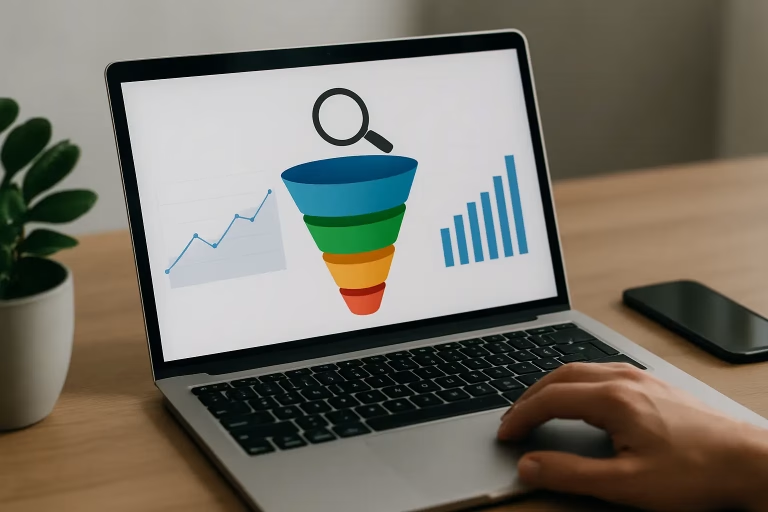
If you remove Instagram, TikTok, or LinkedIn, you still need three things working together. You need traffic, a way to capture that traffic, and an offer that matches the intent of the person arriving. That is the system logic.
Traffic is how strangers enter your world. Capture is how you keep that attention long enough to continue the conversation. Monetization is how the system converts attention into revenue. When those three pieces are disconnected, people blame the platform. Usually the platform is not the issue. Misalignment is.
A calm business is not a traffic-free business. It is a business that uses traffic sources with longer shelf life and less maintenance.
What replaces social media when you still need buyers?
Search-based traffic is the clearest alternative because it reaches people who are already looking for something. That includes blog content, Pinterest search behavior, YouTube search, and search engine results more broadly. Unlike social feeds, these channels can keep sending traffic long after the work is published.
That is where leverage comes from. One article can answer a specific problem for months or years. One optimized product page can keep converting without daily input. One email welcome sequence can continue selling long after it is written.
This is very different from the short half-life of feed content. A social post often disappears within hours. Search-led content compounds.
That does not make it instant. In fact, this is the trade-off. Search-based systems are slower at the start, but more stable over time. Social media can create quick spikes, but often at the cost of constant maintenance. If your goal is long-term income without burnout, slower and steadier is usually the better fit.
The business model matters more than the platform
A lot of people ask whether they can sell online without social media when the deeper issue is that their offer is not built for low-noise acquisition.
Some business models work well without social. Digital downloads, affiliate offers, templates, mini-products, educational resources, and funnel-based service offers can all work quietly if the demand is clear and the customer journey is simple. These offers solve defined problems and do not require a personality-led audience to make sense.
Other models are harder to run this way. If the sale depends on trust built through daily visibility, community energy, or a strong personal brand, social platforms may play a bigger role. That does not mean they are mandatory. It means your offer architecture needs to match your acquisition method.
This is why structured businesses outperform random tactics. If someone lands on your site from a search query, the page they see should match what they were looking for. The opt-in should be a logical next step, not a generic freebie. The email sequence should continue the same conversation. The paid offer should solve the next layer of the same problem.
That is funnel alignment. Without it, even good traffic struggles to monetize.
A simple system for selling without social media
If you want to sell quietly, think less about content volume and more about path design.
Start with one problem. Not ten. Define a narrow issue your audience is actively trying to solve. Then build one entry point around that problem. This could be a blog post, a search-friendly landing page, or a tutorial designed around specific intent.
From there, add one capture asset. That might be a short blueprint, checklist, template, or email lesson tied directly to the original problem. The purpose is not to collect subscribers for the sake of it. The purpose is to move from borrowed attention to owned attention.
Then connect it to one clear monetization path. That could be an ethical affiliate recommendation, a digital product, or a structured low-ticket offer. The point is that the sale should feel like a continuation, not a jump.
For example, if your article is about organizing client onboarding, the opt-in could be an onboarding template. The next step could be a paid systems pack or a software recommendation that supports the workflow. Traffic connects to capture. Capture connects to monetization. Every step has logic.
That is how you sell without being online all day.
Why email matters if you do not use social media
Email is often dismissed because it sounds less exciting than newer channels. That is exactly why it is useful.
If you are not using social media as your daily relationship engine, you need a direct line to people who already showed interest. Email does that. It gives you a private communication channel that is not controlled by an algorithm and does not require constant public presence.
It also gives you room to sell with context. A social post has very little space to educate. An email sequence can build understanding, address objections, and move people toward a decision in a more grounded way.
This matters even more if your audience is thoughtful and slow to buy. Not everyone converts from a quick impression. Some people need structure before action. Email supports that better than most platforms.
What usually goes wrong
The biggest mistake is trying to avoid social media without replacing its function. People stop posting, but they do not build discoverability. Or they start a blog, but every article covers a different topic with no commercial direction. Or they collect email subscribers with a broad freebie that has no connection to what they sell.
The issue is rarely effort. It is system design.
Another problem is expecting a quiet business to require no consistency. Selling without social media still takes work. You still need to publish, optimize, test, and refine. The difference is where that effort goes. Instead of feeding a content machine that resets every day, you are building assets that can keep producing.
There is also a patience requirement. A system-first business can feel slower because there is less visible activity. Fewer likes. Fewer spikes. Less noise. But lower noise is not the same as lower potential. Often it is the opposite.
Can you sell online without social media if you are starting from zero?
Yes, but simplify aggressively.
Do not try to be everywhere except social. Pick one traffic channel that fits your strengths. If you write clearly, start with SEO-focused blog content. If you prefer visual search behavior, consider Pinterest connected to content assets. If you explain well on screen but do not want personal branding, search-led tutorials can work.
Then build one funnel path around one offer. Not a store full of disconnected products. Not five lead magnets. One clear journey.
This is where brands like Miss K Digital have the right framing. The goal is not to avoid social media out of fear. The goal is to build a business that does not collapse when attention shifts. Quiet systems are stronger because they are designed around structure, not momentum.
That is the real answer to the question. Yes, you can sell online without social media. But you cannot sell online without clarity. You need a defined buyer problem, a discoverable entry point, a capture mechanism, and an offer that logically fits what brought the person in.
If you build that well, you do not need to be the brand. The system can do the talking.
And for many people, that is not just more private. It is more sustainable.