Faceless Funnels That Actually Pay Creators
You do not need to show your face to sell.
You need a path.
Most creators who try to monetize without personal branding fail for a boring reason: they post content and hope money appears. That is not a strategy. That is an anxiety hobby.
Faceless funnels for creators fix the real problem – not visibility, but conversion. They give strangers a simple next step, track what happens, and turn “I found your post” into “I bought through your link” without you living on Stories.
What “faceless funnels for creators” really means
A faceless funnel is a system that moves a visitor from interest to action without relying on your identity, lifestyle, or charisma. It leans on clarity, relevance, and timing instead of personality.
Think less “follow me for tips” and more “here is the exact solution for the exact problem you already have.”
This is why faceless funnels work so well for introverts, private builders, and anyone who is done performing online. You are not asking people to like you. You are offering them a logical next step.
But there is a trade-off. When you remove personality from the front end, your structure has to be tighter. Your copy has to do its job. Your offer has to match the intent of the traffic. If your funnel is vague, faceless marketing will feel invisible.
The quiet funnel stack (and why it converts)
A faceless funnel is not one page. It is a sequence.
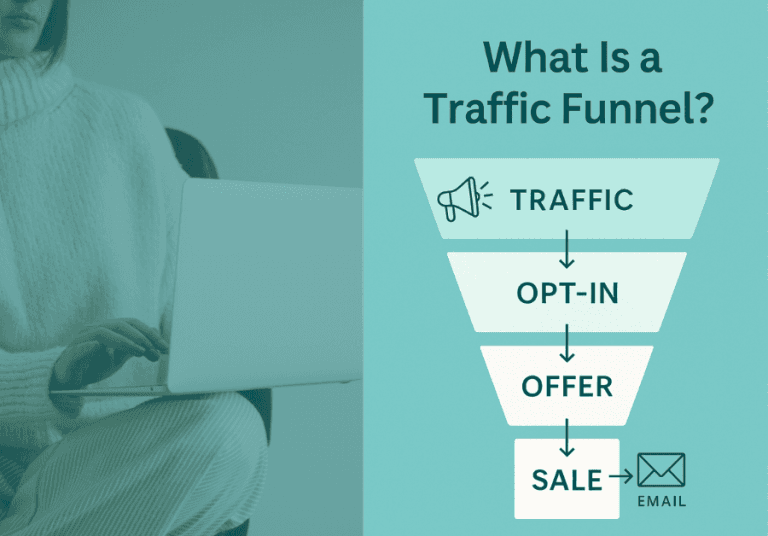
At minimum, you need three things working together: an entry point (how people find you), a capture point (how you keep them), and a conversion point (how they buy). The magic is not any single part – it is the handoff.
The “quiet income” version usually looks like this:
1) Entry point: SEO-first content that answers a specific question
If you want faceless income, you want traffic you do not have to constantly re-earn.
SEO content is not sexy, which is exactly why it is so effective. A well-written blog post or YouTube tutorial can bring in clicks while you are offline. Social posts are rentals. Search traffic can be an asset.
The key is intent. “Best email marketing tool for beginners” converts differently than “email marketing tips.” One is shopping. One is browsing. If you are building affiliate income, you want more shopping intent pieces in the mix.
2) Capture point: a lead magnet that solves a tiny problem fast
If a visitor reads your content and leaves, you are relying on them to remember you. They will not.
A faceless funnel turns that one-time visitor into an owned contact (usually email). Not with a 47-page ebook, but with something that feels immediately useful:
A checklist. A swipe file. A setup guide. A “pick the right tool” quiz. A 10-minute mini training.
Your lead magnet is not your life’s work. It is a bridge.
3) Conversion point: an offer that matches the original reason they clicked
This is where most creators fumble. They write an SEO post about a tool, then send people to a random digital product, then wonder why nobody buys.
Match matters.
If the entry topic is “how to start an email list,” the next best step is either (a) a beginner-friendly email platform affiliate recommendation, or (b) a template pack that helps them write the first welcome sequence, or (c) both in a logical order.
A faceless funnel is not pushy. It is coherent.
The page flow that keeps you anonymous and still sells
You can build this with a simple set of pages. You do not need a complicated tech maze. You need the right sequence and clean calls-to-action.
Here is a practical structure that works for faceless funnels for creators, especially for affiliate monetization:
The content page: one job, one next step
Your blog post or video script should do two things: solve the problem it promised, and tee up the next step.
Pick one primary CTA and repeat it naturally.
If you add five different CTAs, your conversion rate will politely disappear. Give the reader a single obvious move: download the checklist, grab the template, start the free trial, etc.
The opt-in page: fewer words, more specificity
Faceless funnels convert when the opt-in page is painfully clear.
Instead of “Join my newsletter,” say what they get and when they get it. Instead of “free guide,” name the outcome.
If you are privacy-minded (you probably are), you can say that too. People like knowing you are not going to spam them.
The thank-you page: where the money starts
A thank-you page is not a receipt. It is a controlled moment of attention.
This is the perfect place to recommend the tool, template, or training that fits what they just opted in for. If your lead magnet is “SEO checklist,” the thank-you page can offer “Here is the keyword tool I use” or “Here is my template pack for writing SEO intros that rank.”
Not hype. Not pressure. Just the next logical step.
The email sequence: the quiet closer
If you want conversion without constant posting, email is the engine.
You are not writing daily diary entries. You are building a short sequence that does three things: deliver the freebie, create confidence, and present the offer.
A simple 5-email structure is often enough:
- Deliver the lead magnet and set expectations.
- Show a quick win (a small result they can get fast).
- Address the common stuck points and objections.
- Recommend the tool or product with a specific use case.
- Follow up with a “if you are still deciding” email that helps them choose.
Notice what is missing: your personal life. Your face. Your origin story. This is about their outcome.
CTAs that do not feel cringe (and still convert)
If you hate “link in bio” energy, good. That means you have standards.
Faceless funnels live or die on CTAs because you are not using personality to carry the ask. Your CTA has to be direct, specific, and aligned with intent.
A strong CTA usually includes one of these: a time saver (“copy/paste”), a risk reducer (“free,” “no card needed”), or a clarity promise (“exact steps,” “what to do first”).
It also avoids vague language. “Learn more” is not a plan. Tell people what happens after they click.
If you want swipeable CTA templates built for stealth-style funnels, that is a big part of what we publish at Miss K Digital.
Automations that keep the funnel running while you rest
Automation is not about being fancy. It is about being consistent without burnout.
At a minimum, set up:
Tagging by intent
If someone opts in from a “best beginner email platform” article, tag them differently than someone who opts in from a “how to write blog posts” article.
This lets you send better recommendations later. It also protects your list from random broadcasts that do not match what they came for.
Behavioral follow-ups
If your email platform allows it, trigger a follow-up when someone clicks your affiliate link but does not convert. The tone matters here. You are not chasing them. You are helping them decide.
A simple “Want me to help you pick the right plan?” email can outperform three generic reminders.
A monthly “refresh” loop
Faceless funnels get stronger when you maintain them. Set a recurring reminder to check top pages, update affiliate links, and improve CTAs.
Quiet income is not set-it-and-forget-it. It is set-it-and-maintain-it.
Common mistakes that make faceless funnels feel like they “don’t work”
Most of the time, the funnel is not broken. The alignment is.
You picked the wrong entry topic
If your content brings in people who are not ready to act, your conversion will be low no matter how good your funnel is. Add more problem-aware and solution-aware topics, not just awareness content.
Your lead magnet is too big or too generic
If it takes an hour to consume, people will save it “for later” and never return. If it is vague, it will not feel worth an email address.
You are sending everyone to the same offer
Faceless funnels are not one-size-fits-all. Segment by topic and intent, even if it is simple.
You are relying on social for traffic anyway
If you are still posting daily to feed the funnel, you did not build a faceless system. You built a content treadmill with an opt-in attached.
If you want the calm version, invest in search-driven content and let time do some of the work.
When faceless funnels are not the best move
It depends on your constraints.
If you are in a relationship-driven niche where trust is heavily personal (some coaching and high-ticket services), going fully faceless can slow conversions. You can still keep privacy while adding trust signals like case studies, transparent process explanations, and a consistent brand persona – but you may need a bit more “human proof.”
Also, if you hate writing and refuse video, SEO-heavy funnels will feel painful. In that case, a faceless funnel can still work through paid ads or partnerships, but your cost goes up. There is no free lunch. You either spend time or money.
The real goal: a system you can repeat
Faceless funnels for creators are not a trick to avoid doing work. They are a way to do the right work once, then let it compound.
Start with one topic, one lead magnet, one email sequence, and one offer. Make that small funnel convert before you build five more.
You are not behind. You are just done performing.
Build the quiet path. Let the system speak for you.
Closing thought: if your current strategy requires you to be “on” every day, it is not a business model – it is a dependency. A funnel is what replaces the dependency with a process.