The Future of Faceless Marketing
A lot of people are not avoiding visibility because they are lazy or scared. They are avoiding it because they have already seen what constant exposure costs. The future of faceless marketing matters for that exact reason. More builders want income systems that do not depend on personality, daily content, or being publicly available on the internet at all hours.
That shift is not a passing preference. It is a structural response to creator fatigue, platform volatility, and the simple fact that attention is harder to hold than most business advice admits. If your growth model only works while you are posting, performing, and staying visible, you do not really have leverage. You have a demanding job with an algorithm attached.
Why the future of faceless marketing is changing
For years, online business advice pushed one main idea – build a personal brand, show your face, and stay top of mind. That approach can work, but it also creates a fragile business model. The moment visibility drops, so can leads, trust, and sales.
Faceless marketing is gaining ground because it solves a different problem. It creates distance between the business and the person running it. That gives more privacy, but more importantly, it forces better structure. When you cannot rely on charisma, your offer, messaging, funnel logic, and traffic system need to do the heavy lifting.
That is why the next phase of faceless marketing will not be about hiding. It will be about designing assets that communicate clearly without requiring your constant presence. Strong written content, search-based traffic, automated email sequences, strategic lead magnets, and aligned affiliate recommendations will matter more than polished personality content.
This is also where a lot of people get it wrong. They hear faceless and think anonymous content farm, recycled AI posts, or a low-trust brand with no point of view. That is not where the market is heading. Low-trust faceless brands will struggle. Clear, useful, well-structured faceless brands will do well.
What will actually define the future of faceless marketing
The future of faceless marketing will belong to businesses that replace visibility with clarity. That sounds simple, but it changes how the whole system is built.
Search intent will beat attention chasing
Short-form platforms still have reach, but reach is not the same as stability. Search traffic, whether through SEO, Pinterest, YouTube search, or platform-native search, brings a different kind of visitor. These people are looking for a solution, not just reacting to content in a feed.
That matters because intent converts more cleanly than passive attention. A faceless brand does not need broad recognition if it appears at the right moment with the right answer. One article, one opt-in, and one email sequence can outperform weeks of posting if the traffic is aligned.
For quieter business models, this is a better trade. You may grow slower at first, but the assets compound. A good article can keep pulling traffic. A well-positioned freebie can keep capturing leads. A structured funnel can keep converting without daily intervention.
Trust will come from proof of structure
Faceless does not mean vague. In many cases, the fastest way to lose trust is to hide behind generic messaging. The businesses that last will be the ones that explain their method clearly, show the logic behind the system, and make the buyer journey feel stable.
That might look like transparent process breakdowns, practical tutorials, useful templates, or a visible content architecture that shows people where to start. You are not asking people to trust your personality. You are giving them enough structure to trust your process.
This is where calm brands have an advantage. You do not need to perform certainty. You need to define the steps, show how the parts connect, and remove unnecessary friction.
Simple automation will matter more than complex stacks
A lot of faceless businesses will overbuild. They will collect tools, automate too early, and end up with a messy backend that is hard to maintain. The better path is usually lower complexity.
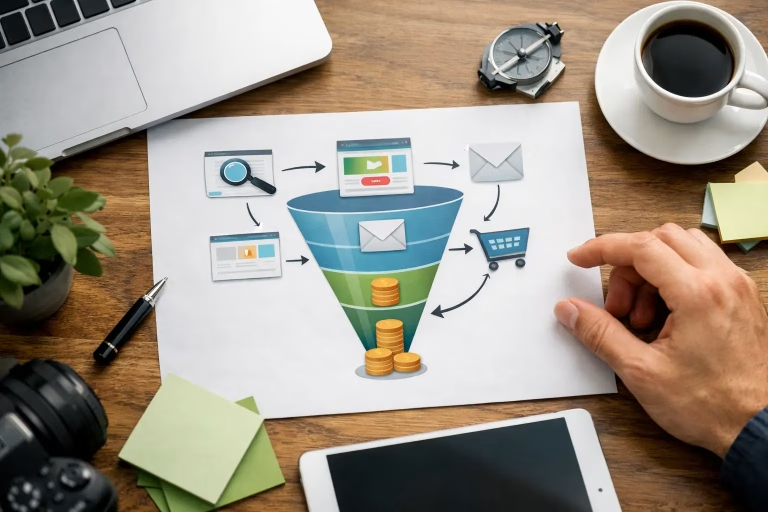
The future is not about building a giant machine. It is about building a clean one. Traffic source, lead capture, nurture sequence, offer path, and follow-up should connect with minimal friction. If a tool does not improve speed, clarity, or conversion, it is often just adding maintenance.
This is especially relevant for burnout-prone builders. A faceless business should reduce noise, not hide chaos behind automation.
The system logic behind sustainable faceless growth
If you strip away the trends, most faceless marketing problems come back to one issue: disconnection. Traffic is not aligned with the offer. The lead magnet attracts the wrong person. The email sequence does not bridge to monetisation. The affiliate recommendation is dropped in without context.
That is why the system matters more than the tactic.
A sustainable faceless model usually starts with one clear traffic input. That could be SEO content, Pinterest pins linked to solution-focused articles, or search-led video content where the message carries the brand without turning the creator into the product. From there, the traffic needs a relevant capture point – not a random freebie, but something that logically continues the same problem the visitor came to solve.
Next comes the funnel layer. This is where a lot of income is either stabilised or lost. The sequence should not just send emails because that is what marketers do. It should move someone from interest to clarity. What problem are they trying to solve? What solution category fits? What offer or affiliate tool makes sense next?
Then comes monetisation. Ethical affiliate marketing fits faceless businesses well when the recommendation sits inside a clear framework. If the product is part of the implementation path, conversion feels natural. If it is bolted on as a revenue grab, trust drops fast.
This is also why the 3-Step Invisible Income System is useful as a reference point. It frames faceless growth the right way – not as content for content’s sake, but as traffic, capture, and monetisation built in sequence. That is the difference between scattered effort and compounding structure.
What will not work going forward
A few versions of faceless marketing are already losing effectiveness.
First, generic AI content with no strategic positioning. Search engines and readers are both getting better at filtering out thin material. If the content says nothing specific, it will not hold attention or build trust.
Second, faceless accounts trying to copy influencer tactics without the influencer. If the whole model depends on trend volume, speed, and platform favour, the business is still unstable. The face was removed, but the fragility stayed.
Third, monetisation without pathway design. A lot of people can get clicks. Fewer can connect those clicks to a useful opt-in, a persuasive nurture sequence, and an offer that fits the original problem. That connection is where leverage comes from.
How to build for the future of faceless marketing now
The practical move is not to predict every platform change. It is to build around what tends to stay useful.
Start with one traffic channel that rewards search intent or evergreen discovery. Pair it with a focused capture asset tied to a specific problem. Build a short email sequence that educates, qualifies, and points to one next step. Then review your monetisation layer and ask a simple question: does this offer genuinely complete the journey the visitor started?
If not, the issue is probably not traffic. It is alignment.
Keep your tool stack light. Prioritise systems you can maintain quietly. Write messaging that explains the framework instead of trying to sound bigger than you are. Make the brand useful enough that trust can form without overexposure.
If you want the complete structure behind that approach, the 3-Step Invisible Income System is the natural next step. It lays out how traffic, lead capture, and monetisation fit together when the goal is long-term digital income without relying on personal branding.
The real opportunity here is not disappearing from the internet. It is building something that still works when you step away from it for a day.